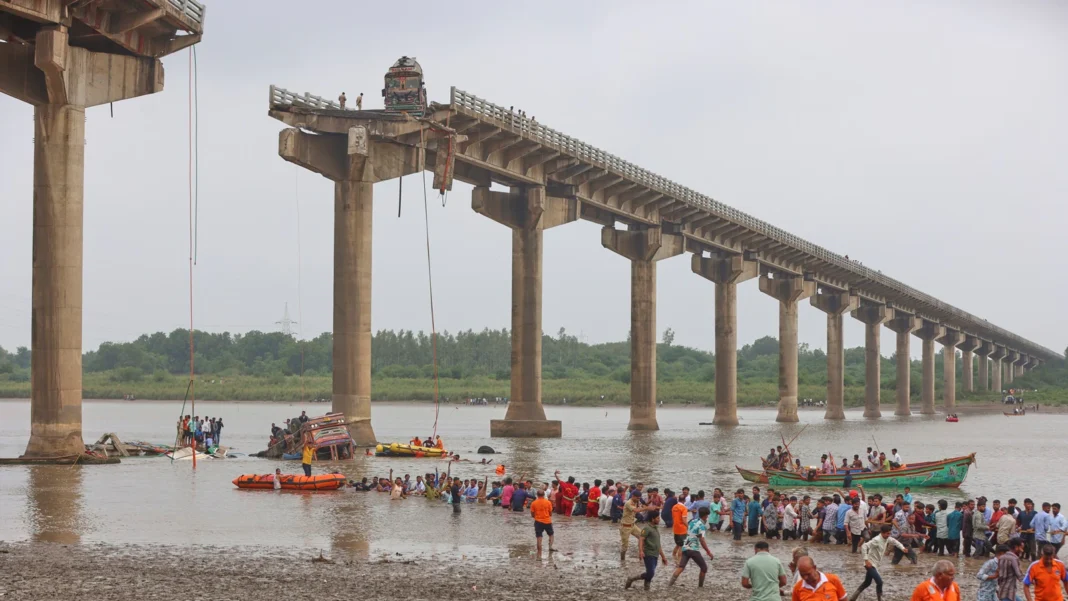
The tragic collapse of a bridge in Vadodara has once again shaken public faith in the integrity of our infrastructure and the accountability of those entrusted with maintaining it. With over a dozen lives lost, families shattered, and fingers pointed in all directions, the official explanation offered—“structural failure”—feels more like an evasion than an answer. As citizens mourn, the pressing question remains: will justice truly be served for those who suffered and lost?
This was not a natural calamity or an unforeseeable accident. It was, by all accounts, a human-made disaster. When a bridge collapses in broad daylight, taking innocent lives along with it, and officials attribute it to structural failure, one must ask—who allowed that structure to deteriorate? Who signed off on its safety? Who buried the reports that raised alarms? And who now is responsible for these irreparable losses?
A History of Warnings, a Future Ignored
The most unsettling part of this tragedy is that the collapse was not without warning. Multiple technical assessments had reportedly deemed the bridge unsafe in recent years. Local voices had raised red flags, pointing to cracks, weak support, and evident deterioration. Yet the bridge remained open, heavy vehicles continued to pass over it, and no meaningful reinforcement or repair was undertaken.
This pattern is not new. India has seen several such collapses in recent years. What is common in almost all these cases is a disturbing negligence—a failure to act in time despite prior knowledge of danger. In essence, what happened in Vadodara is not just a structural failure; it is a governance failure.
Suspensions and Compensation: The Standard Template
As news of the collapse spread and public outrage mounted, the government responded swiftly with the usual template—suspending a few officials and announcing compensation for the victims’ families. While suspensions may serve to momentarily deflect criticism, they are hardly a substitute for deep accountability. More often than not, these suspensions are temporary, and after the public attention fades, the same individuals find their way back into the system.
Compensation, though essential, also raises questions. Is ₹4 lakh an adequate price for a lost life? Is ₹50,000 enough for a survivor bearing lifelong injuries, trauma, and financial insecurity? While monetary relief can help families in the short term, it does not absolve the state of its duty to protect citizens from preventable tragedies. Nor does it deliver justice.
Accountability Must Go Beyond Paperwork
If true justice is to be served, it must go beyond symbolic gestures. What’s needed is a full-fledged criminal investigation into how this tragedy occurred. Were maintenance audits ignored? Was budget allocation diverted? Were tenders handed out without proper oversight? Who signed off on the bridge being safe for use?
The families of the victims deserve answers—and not just through press statements but in courtrooms. Legal accountability must not stop at lower-level engineers or clerks. Senior officials, contractors, and even political leaders—anyone who played a role in either facilitating or ignoring the conditions that led to the collapse—must be brought under the purview of the investigation.
Negligence that leads to death is a criminal offense. The law provides clear avenues for charging those responsible under applicable sections for criminal negligence, public endangerment, and even manslaughter. The judicial system has both the tools and the authority to ensure that this does not end up being another open-and-shut case of bureaucratic lip service.
Will the Judiciary Step In?
In previous instances of infrastructure collapse, the courts have taken suo motu cognizance or responded to public interest litigations seeking accountability. The judiciary in India has played a significant role in upholding public safety where the executive has failed. This case must be no different.
An independent judicial inquiry, preferably monitored by a high court bench, should be commissioned. This body must have access to all documents, contracts, audit reports, maintenance logs, and communications pertaining to the bridge over the past decade. Only then can the truth be uncovered—and only then can guilt be assigned.
Additionally, compensation must not just come from taxpayer money. If negligence is proven, those found guilty—whether government bodies or private contractors—must be made liable for damages, both financially and criminally.
Systemic Reform: More Than Just a Crisis Response
One tragic collapse should lead to a national reckoning. If a bridge can fail despite warnings and technical reports, how many other such structures across the country are ticking time bombs? There must be a national audit of aging infrastructure, a reform of the tendering process, and stronger enforcement of safety certifications. Routine inspections must be made public and independently verified.
The truth is, infrastructure in India is too often compromised by cost-cutting, corruption, and a lack of long-term planning. Civil engineering is not merely about laying concrete and steel—it is about safeguarding human lives. When accountability disappears from the process, human life becomes collateral damage.
Justice Is Not a Statement—It Is an Action
For the families who have lost loved ones, justice cannot just be a word spoken in press conferences or written in government memos. It must be seen, felt, and enacted in real terms—through punishment of the guilty, support for the bereaved, and structural reforms that ensure no one else suffers the same fate.
Justice will be served not when compensation is paid, but when those responsible are convicted; not when committees are formed, but when their findings lead to action; not when attention fades, but when systemic change is implemented.
The people of Vadodara, and indeed all of India, deserve a government that values human life over cost, integrity over shortcuts, and justice over optics. Anything less would mean that the victims of the Vadodara bridge collapse died not from a structural flaw—but from the rot within our institutions.