
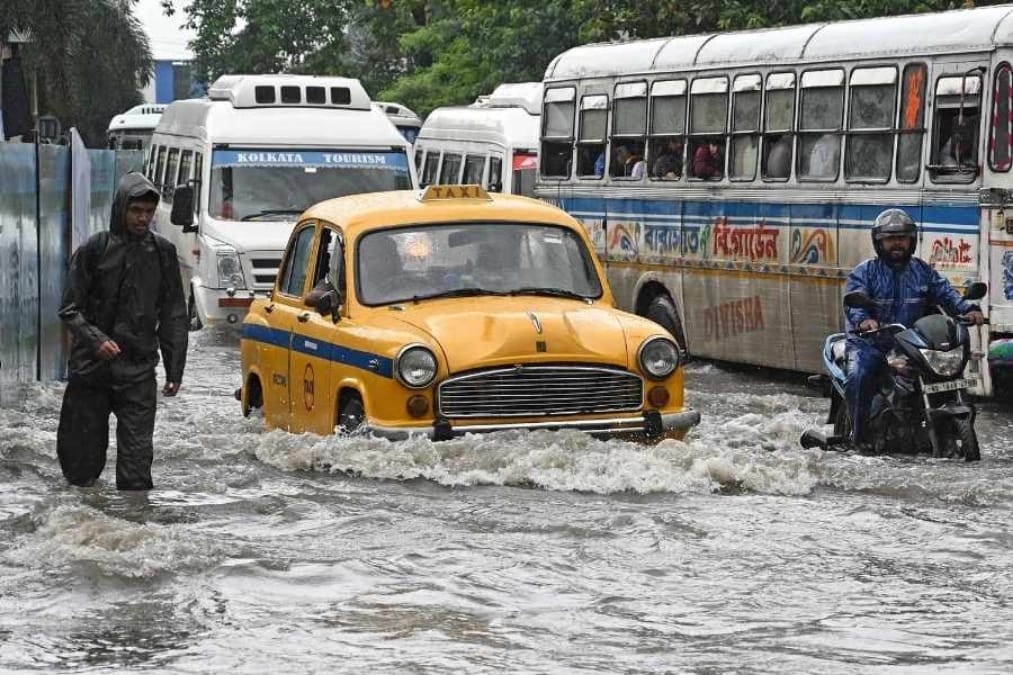
Kolkata was brought to a grinding halt on Tuesday after one of the heaviest single-day downpours in decades left the city waterlogged, paralyzed public transport, and claimed at least ten lives. According to the India Meteorological Department (IMD), the city received 247.4 mm of rainfall between 8.30 am Monday and 8.30 am Tuesday, with most of it concentrated in the early hours. The deluge marked the sixth-highest single-day rainfall in the city in 137 years and the heaviest since 1986.
In an unprecedented spell, some parts of south Kolkata witnessed over 300 mm of rain within hours, far exceeding the seasonal average. Neighborhoods like Garia Kamdahari (332 mm), Jodhpur Park (285 mm), Kalighat (280 mm), and Ballygunge (295 mm) emerged as the worst-hit areas, with knee- to waist-deep water reported across several localities.
Extreme Weather Triggered by Bay of Bengal Low
The IMD attributed the historic rainfall to a low-pressure system over the northeast Bay of Bengal that lashed Gangetic West Bengal, including Kolkata, Howrah, and Hooghly. Meteorologists emphasized that while Kolkata received a maximum hourly rainfall of 98 mm between 3 am and 4 am, it did not qualify as a cloudburst, defined as more than 100 mm of rainfall in an hour over a limited area.
Data showed the scale of the deluge: the city received 2,663 per cent more rainfall than its long-term average in just 24 hours. Neighboring districts too recorded extraordinary figures, with Howrah logging 1,006 per cent above normal and North 24 Parganas registering 857 per cent more than average rainfall.
Officials have cautioned that heavy rain is likely to continue across districts like Purba and Paschim Medinipur, South 24 Parganas, Jhargram, and Bankura until Wednesday, with a fresh low-pressure system predicted around September 25.
Transport Crippled, Flights Cancelled
The downpour crippled life across large parts of Kolkata. Arterial roads such as EM Bypass, AJC Bose Road, and Central Avenue were waterlogged, leaving vehicles stranded and commuters helpless. Several areas, including Park Circus, Gariahat, and Behala, experienced waist-deep water, making movement nearly impossible.
Metro services were severely disrupted, with operations suspended between Shahid Khudiram and Maidan stations, while truncated services ran between Dakshineswar and Maidan. Railway operations also came to a near halt, as Eastern Railway suspended train services in the Sealdah south section due to flooded tracks.
At Netaji Subhas Chandra Bose International Airport, operations took a heavy hit. At least 30 flights were cancelled and 31 delayed due to poor visibility and continuous rain. Airport authorities confirmed that aircraft remained grounded as safety concerns mounted.
Political Reactions and Relief Efforts
Chief Minister Mamata Banerjee described the torrential downpour as “unprecedented,” saying, “I have never seen rain like this.” While expressing grief over the loss of lives, she strongly criticized the Calcutta Electric Supply Corporation (CESC) for failing to prevent electrocution-related deaths, which killed up to seven people. She demanded that CESC provide jobs to affected families and modernize infrastructure to prevent such tragedies.
Municipal authorities worked round the clock to drain excess water, but officials admitted that relief operations were hampered by high tide around 1.30 pm, delaying the flow of water into the Hooghly River. Mayor Firhad Hakim warned that the inundation might persist until late Tuesday night.
With Durga Puja just days away, the flooding has raised concerns about preparations, but the Chief Minister has postponed all city-based inaugurations to prioritize relief efforts, opting for virtual participation in unaffected districts instead.

