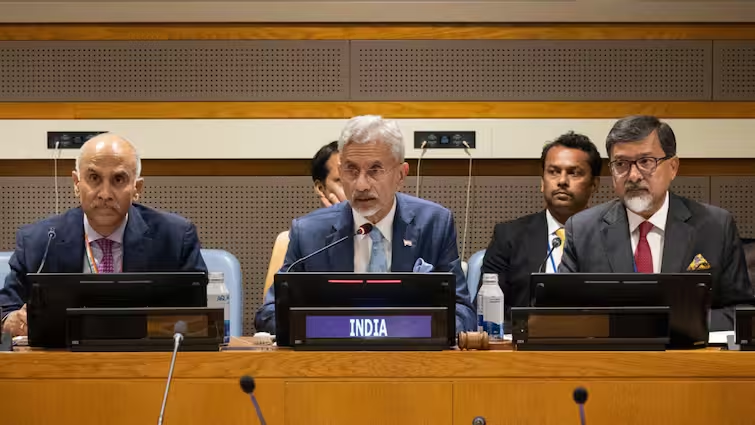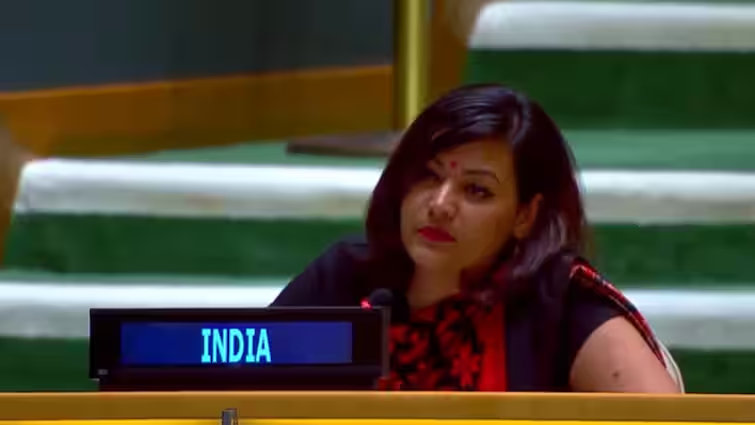
In a forceful right of reply at the United Nations General Assembly (UNGA), India launched a scathing rebuttal to Pakistan Prime Minister Shehbaz Sharif’s remarks regarding Kashmir and the Indus Waters Treaty, describing them as “absurd theatrics” aimed at deflecting attention from Pakistan’s own track record of sponsoring terrorism.
Exercising India’s right of reply, Petal Gahlot, First Secretary at India’s Permanent Mission to the UN, said that Pakistan had once again used the global platform to “glorify terrorism” and propagate falsehoods. Gahlot’s response came hours after Prime Minister Sharif’s address, where he reiterated Pakistan’s position on Kashmir and accused India of violating the 1960 Indus Waters Treaty.
India Responds with Strong Language
Addressing the Assembly, Gahlot said, “Mr. President, this Assembly witnessed absurd theatrics in the morning from the Prime Minister of Pakistan, who once again glorified terrorism that is so central to their foreign policy. However, no degree of drama and no level of lies can conceal the facts.”
Gahlot’s remarks underscored India’s consistent stand on Pakistan’s support for cross-border terrorism and the repeated use of international forums by Islamabad to make “false and baseless” allegations against New Delhi.
She referred specifically to an incident earlier this year, highlighting Pakistan’s move to shield a known terror group at the UN Security Council. “This is the very same Pakistan which, at the UN Security Council on 25th April 2025, shielded The Resistance Front — a Pakistani-sponsored terror outfit — from the responsibility of carrying out the barbaric massacre of tourists in the Indian Union Territory of Jammu and Kashmir,” Gahlot stated.
The attack in question occurred in April in Pahalgam, a popular tourist destination in Jammu and Kashmir, and resulted in the death of 26 civilians, including foreign nationals. The Resistance Front, widely believed to be a proxy of the banned Lashkar-e-Taiba, was accused of orchestrating the attack.
Accusations of Harboring Terrorists
The Indian diplomat took aim at what she described as Pakistan’s “long tradition” of supporting and exporting terrorism. She pointed to historical examples, including the country’s sheltering of Osama bin Laden, the mastermind behind the 9/11 attacks, who was found and killed by U.S. forces in Abbottabad in 2011.
“Let us recall that it sheltered Osama bin Laden for a decade, even while pretending to partner in the war against terrorism,” said Gahlot. “Its ministers have just recently acknowledged that they have been operating terrorist camps for decades. It should come as no surprise that once again this duplicity continues, this time at the level of its Prime Minister.”
India’s response also accused Pakistan of deliberately deflecting attention from its internal governance crises and economic turmoil by focusing on Kashmir — a long-standing flashpoint between the two nuclear-armed neighbours.
Sharif’s Remarks on Kashmir Draw Strong Rebuke
Earlier in the day, Prime Minister Shehbaz Sharif had devoted a significant portion of his UNGA address to the Kashmir issue. He spoke directly to the people of Kashmir, stating, “I wish to assure the Kashmiri people that I stand with them, Pakistan stands with them, and one day soon India’s tyranny in Kashmir will come to a halt.”
India dismissed these remarks as “a desperate attempt to internationalize a bilateral issue and to once again justify cross-border terrorism under the guise of political support.”
Gahlot said, “Pakistan’s obsession with Kashmir is nothing more than an attempt to divert attention from the dire state of its economy, the silencing of dissent, and systemic human rights violations within its own borders — including in Balochistan, Khyber Pakhtunkhwa, and Sindh.”
India has long maintained that Jammu and Kashmir is an integral part of the country, and any issues related to it are internal matters.
Indus Waters Treaty Dispute
Another key point of contention in Sharif’s speech was India’s decision earlier this year to place the Indus Waters Treaty in abeyance. Calling the move a “breach of international law” and an “act of war”, Sharif claimed India’s actions were unjustified and detrimental to regional peace.
India had suspended the treaty after the April Pahalgam terror attack, citing national security concerns and Pakistan’s continued support for terror outfits targeting Indian civilians.
Gahlot did not directly address the treaty in her reply at the Assembly, but Indian officials have previously stated that the treaty — though a symbol of long-standing cooperation — cannot exist in a vacuum of trust and must be re-evaluated in light of Pakistan’s conduct.
Broader Diplomatic Implications
The exchange marks yet another chapter in the deeply strained diplomatic relationship between the two neighbours. Since India’s abrogation of Article 370 in August 2019, which revoked Jammu and Kashmir’s special status, ties between the two countries have deteriorated sharply.
While both countries have continued to maintain diplomatic representation at the UN and other international forums, backchannel talks have failed to yield substantial progress on key issues — particularly terrorism and Kashmir.
Analysts say the verbal sparring at the UNGA is unlikely to change ground realities but may influence how global powers perceive the long-standing conflict.
India has consistently received support from countries like France and the U.S. on its stance against terrorism, while Pakistan continues to highlight what it calls human rights violations in Kashmir. However, the international community has largely urged both nations to resolve their issues bilaterally.