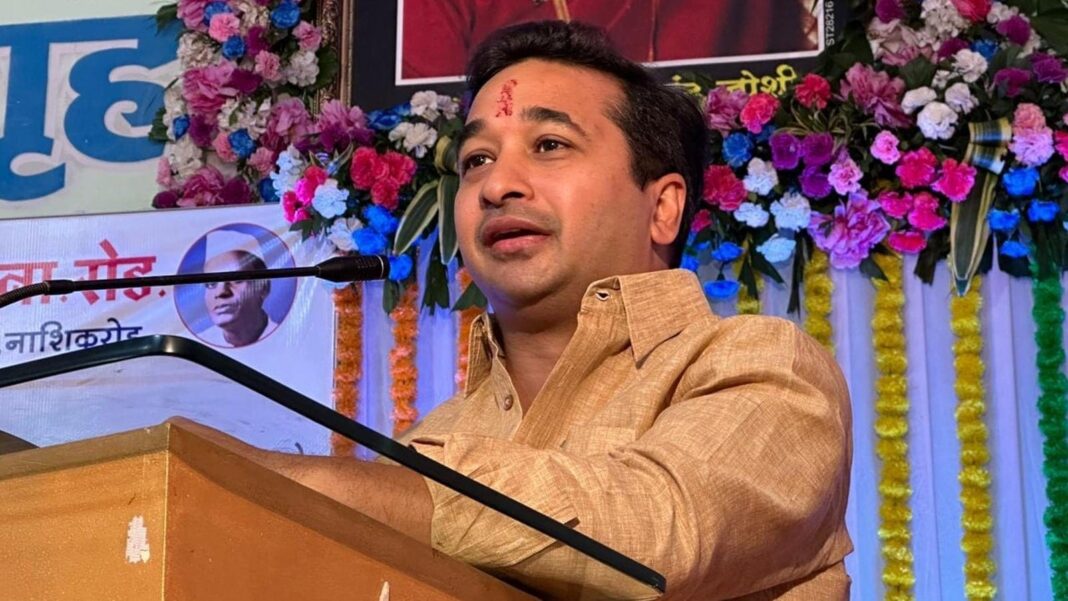
Mumbai, Maharashtra – Maharashtra Minister Nitesh Rane has stirred controversy by suggesting that madrasas in the state should begin teaching Marathi. His remarks have ignited debate across the political and cultural spectrum, coinciding with ongoing discussions on the state’s language policy and the role of regional languages in education.
Language Policy in Focus
The controversy emerges at a time when Maharashtra is revisiting its language education policy. Chief Minister Devendra Fadnavis recently clarified that while Hindi will not be made mandatory, Marathi will be compulsory in all schools, including CBSE and ICSE-affiliated institutions.
Under the New Education Policy (NEP), students are allowed to study three languages, two of which must be Indian. The government has emphasized that promoting Marathi is key to preserving Maharashtra’s cultural heritage and identity.
Rane’s Comments on Madrasas
In a provocative statement, Nitesh Rane suggested that madrasas should also teach Marathi to align with the state’s educational goals and promote inclusivity. Rane also called for the introduction of the Bhagavad Gita in urban areas, including Muslim-majority localities, as part of what he described as a “transformation of thoughts” to align with the idea of a Hindu Rashtra.
His comments have drawn strong reactions, with critics accusing him of communalizing education and promoting cultural nationalism at the cost of secular and linguistic pluralism.
Reactions and Political Backlash
Opposition parties and civil society groups have condemned the remarks, calling them divisive and contrary to the secular fabric of the Constitution. Literary figures and educationists have responded by demanding stronger government commitment to promoting Marathi without imposing it through controversial means.
At the same time, several voices from the ruling party and pro-Marathi organizations have supported the idea, stating that every resident of Maharashtra should be proficient in the state language.
Government’s Clarification
In response to the uproar, the Maharashtra government reiterated its commitment to protecting Marathi while respecting linguistic and cultural diversity. It also assured that no Marathi-medium schools will be shut down and that sufficient resources will be allocated for effective Marathi teaching in all institutions.
What Lies Ahead
As the debate over language, identity, and education intensifies, the future of language policy in Maharashtra will likely be shaped by how the government manages the balance between regional pride and national integration. The implications will extend beyond madrasas, influencing the entire educational framework in the state.